
Awareness of macular degeneration is growing. This is a very good thing, people are coming for an eye examination because of public education campaigns about the importance of regular eyecare.
From an optometrist’s viewpoint, it is always a heartsink moment when I see early signs of macular degeneration. Depending on what people know about this condition, hearing this information can be very distressing. This can be a shock which can impact on understanding or even hearing the rest of the consultation and the implications of the diagnosis.
Here are some of the questions which frequently arise:
What can I do?
There are four main ‘modifiable’ risk factors;
Do not smoke
Look after your vascular health; see your GP regularly for checkups and routine blood tests and follow their advice.
Protect your eyes from UV light; use a hat and your prescription glasses or sunglasses.
Eat as well as you can.
What is ‘dry’ macular degeneration?
This is the most common type of macular degeneration. Deposits accumulate under the macular. There will not be any fluid in the retina. Over time these deposits interfere with the performance of the photoreceptors, affecting vision.
Is there any treatment for ‘dry’ macular degeneration?
Not yet. Although there are trials underway at the moment and the results will show if these are beneficial.
Will I need eye injections?
Macular degeneration causes progressive degenerative changes to the retina. In some cases there is fluid which accumulates in the macular. This is commonly referred to as ‘wet’ macular degeneration. In these cases changes in vision are usually much more noticeable, including distortion. There is a treatment, which is delivered by injection. Many people have ‘wet’ macular degeneration treated this way, and sometimes the outcomes can be quite good.
You will only have this treatment if there are signs of ‘wet’ macular degeneration.
How quickly will this advance? Will I be able to drive in the future?
If you are having regular eye examinations, we most commonly identify macular degeneration in its ‘early’ stages. This is when changes are seen in the eye, but vision is entirely uneffected.
Over time macular degeneration will progress. In some cases, fortunately, the changes are slow.
We use the term ‘intermediate’ to describe advancing macular degeneration which is starting to impact on vision. Changes can be difficulty reading. When we measure your vision on our chart you will not be able to see the smaller letters. At this stage most people will still meet the vision requriements for a car licence. So you are managing, but you have noticed changes.
‘Advanced’ macular degeneration occurs as the condition progresses. There are larger areas of the retina where the photoreceptors do not work. As the condition progresses so does its impact on vision. At this stage people will no longer see well enough to drive.
The term ‘geographic atrophy’ is used to describe advanced macular degeneration changes in the retina.
If you have early macular degeneration my recommendations are:

A healthy diet can help your eye health
Read the material from Macular Degeneration NZ - their handouts and website are excellent.
Put the Amsler Grid somewhere handy and check it regularly.
Do an audit of your diet to make sure you are covering all the recommendations. If not, consider supplements.
Take a careful look at home lighting and make any improvement possible. Particularly useful is to increase light levels in places you like to read. This can make an appreciable impact on your reading. Daylight lamps are excellent.
Same goes for magnifying glasses. Often these can be buried in a drawer somewhere. Clean them and leave them in the kitchen and bathroom where they are easily accessible for reading small print on labels.
Prepare for the worst and hope for the best, but start small. Don’t leap straight to thinking about not driving and having to move house. Instead channel that energy into trying new technology. Have you listened to an audio book from the library? Can you take a photo of a label with your phone and magnify it? Have you ordered groceries online?
Talk to your friends and peers. There may be people you know in the same situation, and hearing their stories can be very helpful.
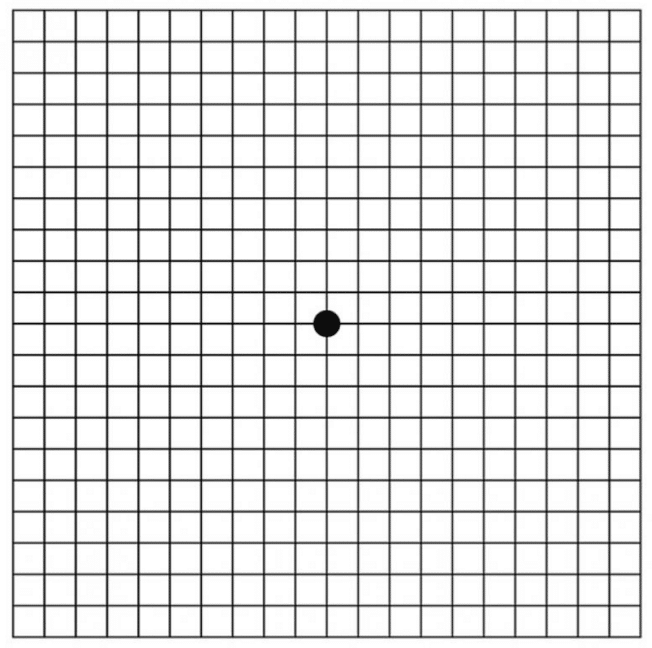
The Amsler grid can help detect early sign of retinal disease and monitor changes in vision after diagnosis.
Remember to talk to your optometrist. When you have had time to process the information if you have questions come back to us, we are here to help.
