Is screen time harming children's eyesight?

There has been a significant onslaught in the use of technology by our children and teenagers, as the world around us becomes more reliant on screens, all of the time. Children are accessing screens at school, around the home, in the community and for personal entertainment at younger and younger ages.

Kids on screens.png

At the same time, there has been an unprecedented increase in myopia (short sightedness) in children, with higher numbers and earlier age of onset. So is this correlation or causation? It’s seems sensible to blame the screens, but nothing is ever that simple. Increased screen time can be associated with more near work, more indoor time and less outdoor exposure.

Is myopia caused by screen time, or are they co-existing features of the modern visual environment? The increase in myopia rates occurred before the saturation of screens in society, with rates of short sightedness in East Asia increasing before the technology took hold. (1)  Analysis has showed no significant association between screen time and myopia. But even when no statistical association was found, children who were myopic spent more time using screens.

We do know there is an association that children whom spend limited time outdoors, and more time at near have increased rates of myopia, and it may simply be that the screens have replaced other near work modes. (1) This could be supported by the fact that whilst screen time has dramatically escalated in children, the myopia rates, whilst increasing, have not exponentially exploded.

Part of the challenge to figure this out scientifically, is that to ascertain device usage, most studies use surveys and questionnaires. These immediately compromise the data, and are likely not as reliable as objective measures. Who wouldn’t down play the amount of time they spend on social media! A novel survey used data usage as an objective measure of time spent on the device, and correlated that to frequency of myopia.(2) They found a significant relationship between increased data usage and myopia - the myopes used almost twice as much data per day as non-myopes. As a cross-sectional study, the authors were unable to measure the impact of screen time on myopia progression, but they did find that more data usage co-existed with higher myopic refractive error.

How much are children actually looking at screens?

Kids on screens (1).png

A Philadelphia study suggested that at age four, half of children had their own TV and three-quarters had their own mobile devices. (3) The data usage study suggested that teenagers dedicate double the time to smartphone use than they do to all other near work, and each younger age group spends more time in bed on the devices than the one before them. (2) I can confirm this one from personal observation in my own home!  A 2011 study suggested 47% of children were spending more than two hours a day on screen time for entertainment, (4) and by 2019 that number had skyrocketed to 98% in the US! (5)

What advice should we be giving you?

When families pay attention to their media consumption and parents monitor their children’s digital access, the amount of screen time reduces along with positive improvements in sleep and school performance.(6)  We know there is a protective effect of outdoor time on the onset of myopia, so it is sensible to recommend outdoor time away from any near activities.

The World Health Organization recommends at least 60 minutes of moderate to vigorous physical activity for school aged children per day, yet a UK survey found that three-quarters of UK children aged 5-12 years spend less time than this outside - which is less time spent outside than prison inmates! Shockingly, 20% of the children surveyed never play outside regularly. When it comes to myopia prevention, though, it’s not the physical activity that is the crucial element, it is likely the light exposure (7) - so to combine both benefits, this physical activity time can be undertaken outdoors.

Our advice:

Need more ideas and help? Check out these brilliant resources.

Close Work and Screen Time for Kids

How Much Time Should My Child Spend Outdoors

References.

1 Lanca, C. & Saw, S. M. The association between digital screen time and myopia: A systematic review. Ophthalmic & physiological optics : the journal of the British College of Ophthalmic Opticians 40, 216-229, doi:10.1111/opo.12657 (2020)

2 McCrann, S., Loughman, J., Butler, J. S., Paudel, N. & Flitcroft, D. I. Smartphone use as a possible risk factor for myopia. Clinical and Experimental Optometry n/a, doi:10.1111/cxo.13092

3 Kabali, H. K. et al. Exposure and Use of Mobile Media Devices by Young Children. Pediatrics 136, 1044-1050, doi:10.1542/peds.2015-2151 (2015)

4 Maniccia, D. M., Davison, K. K., Marshall, S. J., Manganello, J. A. & Dennison, B. A. A Meta-analysis of Interventions That Target Children's Screen Time for Reduction. Pediatrics 128, e193-e210, doi:10.1542/peds.2010-2353 (2011)

5 Madigan, S., Browne, D., Racine, N., Mori, C. & Tough, S. Association Between Screen Time and Children’s Performance on a Developmental Screening Test. JAMA Pediatrics 173, 244-250, doi:10.1001/jamapediatrics.2018.5056 (2019)

6 Gentile, D. A., Reimer, R. A., Nathanson, A. I., Walsh, D. A. & Eisenmann, J. C. Protective effects of parental monitoring of children's media use: a prospective study. JAMA Pediatr 168, 479-484, doi:10.1001/jamapediatrics.2014.146 (2014)

7 Read, S. A., Collins, M. J. & Vincent, S. J. Light Exposure and Eye Growth in Childhood. Investigative ophthalmology & visual science 56, 6779-6787, doi:10.1167/iovs.14-15978 (2015)
ADHB Greenlane Eye Clinic Referral Process for Cataracts

Here is some information on the referral process for outpatient appointments at the Greenlane Eye Clinic. This eye clinic is a free service provided by our District Health Board (DHB).

cataract-pic.jpg

Cataracts

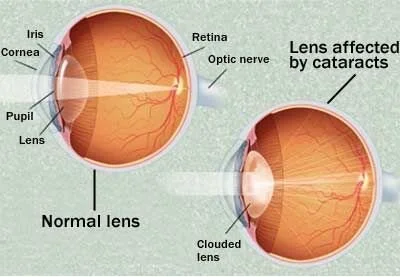
The most common reason we refer people to the Eye Clinic is cataracts. Cataracts are clouding of the lens inside the eye, which reduces vision. The treatment is a surgical procedure, performed under local anaesthetic, to remove the clouded lens, replacing it with an implant. This is usually a highly effective procedure which fully restores vision. No surgery is without risk and this is a consideration when treatment should be undertaken.

Clinical Prioritization Scores

In order to prioritize who gets cataract surgery each year, optometrists and ophthalmologists use a clinical scoring tool. We enter your vision, as recorded at your appointment which is the size of the letters you could read on the chart with the best prescription lenses in place. Also included are details of the examination of your eyes and cataracts.

The final part is your ‘Patient Impact on Life Questionnaire’. With this questionnaire they grade the degree of difficulty your blurred vision is causing you, put another way, it describes how blurred vision may be limiting your life.

Once these details are entered the tool calculates a score. For Auckland DHB the magical number of 48 and above means the referral will be accepted and you can expect to receive an appointment within 16 weeks. Northland DHB has a threshold score of 54.

In our experience this system seems to work, and people we see who are struggling with their vision due to cataracts do in fact get an appointment and go on to have cataract surgery.

Cataracts in both eyes - will both eyes be treated?

Most often cataracts do effect both eyes, although commonly the vision will be worse in one eye. The usual process is to treat the first eye and review. For many people the effect is a significant improvement to their vision, and often the second eye is not treated. Why have a second surgery when you will not notice any difference? This situation is assessed on a case by case basis.

If you have a concerns about cataracts, book to see us.

Book an Appointment Online

or call us on 09 425 9646

Please NO EYE RUBBING

Kids on screens (2).png

People rub there eyes for a variety of reasons. Eyes can feel dry, burning, and itchy, and it seems that giving them a good rub will make them feel better - BUT DON’T DO IT!

For lots of good reasons eye rubbing is never a good idea. In an allergy situation it just makes everything worse. A safe alternative is eye drops or cool compresses - cool flannel or gel pack applied very gently.

Your eyelids, guess what, you’ve got one pair to last a lifetime. They are delicate. Gravity and a lifetime of blinking are going to change the structure of the eye lids and how effectively your blink reflex works to keep the surface of your eye moist and comfortable. Rubbing will honestly not be good in the long term.

This is particularly important for people who are at risk of developing keratoconus. This is condition where the cornea becomes distorted.

So if you need any further encouragement here is a video of an MRI of a violent knuckle rub to an eye. Dr Damien Gatinel, an ophthalmologist who looks after people which keratoconus studies eye rubbing using MRI imaging.

Measuring the Eye - Axial Length

The thing with health science is it keeps evolving! So let me explain what axial length measurement is, why this is useful, and who should be having their eyes measured this way.

As you may know already, we are concerned about the myopia epidemic. An increasing number of people world wide are becoming short-sighted, at a younger age.

Why is myopia a concern? Short-sighted eyes are often longer than an average eyeball, and this is associated with increased risk of eye disease in life.

Fortunately we now have a number of treatment methods which clinical studies have shown to slow down the progress of myopia in children. (Including Miyosmart spectacle lenses, soft contact lenses, and ortho-K contact lenses.)

How does the Eye Axial Length Measurement fit in? If we can identify eyes which are longer than expected, armed with this information we can try to harness as many strategies as possible, and monitor these eyes closely.

Conversely it will be reassuring to know if an eye is average length.

Biometer.jpg

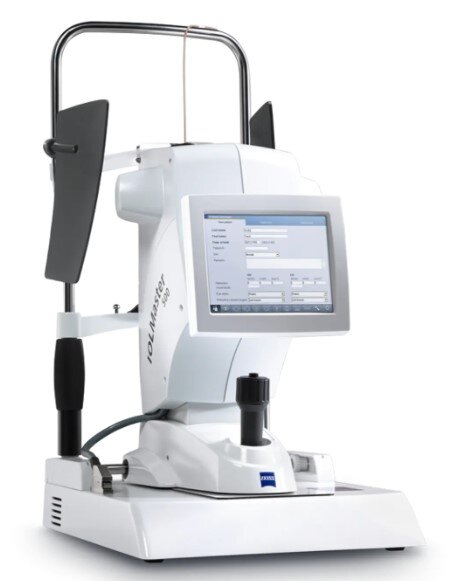
How is Axial Length (AXL) measured? There are a number of methods, but the easiest uses an biometer. This is a painless and non invasive - no eye drops.

A measurement scan using optical low coherence reflectometry (OLCR) biometry measures the axial dimensions of the human eye. From the cornea (at the front) to the retina (at the back). These instruments are readily available in a Ophthalmologist’s (eye specialist) clinic for measurements before cataract surgery.

Who should have their eyes measured? We recommend young people who are myopic, especially those identified as at risk of rapid progression. These are children with highly myopic parents, children who present needing a high prescription at the start and children who are at primary school when they need their first pair of glasses.

How often should eyes be measured? As this is a new clinical procedure we plan to measure once and review. We may recommend a second annual measurement for eyes which appear to be of normal length, if the prescription progresses.

For eyes identified as longer AXL we will likely recommend a review sooner.

Where do I go? Book to see Dr Mark Donaldson, ophthalmologist, at Rodney Surgical Centre, Morrison Drive, Warkworth. Phone 09-425 1190. Request an appointment for Myopia Eye Measurement.

What is the charge? The appointment fee is $75.00

Related Articles: New spectacle lens for Myopia Control - Myoismart

Myopia Control

New Spectacle Lens for Myopia Control - Miyosmart

It is exciting to finally have a new option to help young children who are becoming myopic (short-sighted) - Miyosmart. This is a novel spectacle lens designed specifically to help slow the progression of myopia.

When young people present to us with blurred vision and we discover they are myopic, our hearts sink. We know, from clinical experience, that myopia is likely to get worse in the upcoming years. This results in the eye actually lengthening, which creates a lifelong risk of sight threatening eye conditions. (We have more information about the myopia epidemic, and myopia control contact lenses.)

Facebook post_artwork1.jpg

Miyosmart is a lens specifically designed to treat myopia, with studies that show this lens slows progression by half.

How does it work? The lens has a central zone, which will give clear vision in the distance. In the treatment outer zone of the lens numerous small dimples create defocus on the peripheral retina. This peripheral focus is believed to slow the growth and elongation of the eye.

Facebook post_artwork4.jpg

The study in Hong Kong followed 160 young people over two years. Myopia for the the 79 Miyosmart wearers progressed at half the rate of the group wearing the traditional single vision spectacle lenses.

How does this compare with other types of glasses lenses we have been using? Whenever possible we avoid single vision lenses, instead using lenses which are progressive. These have been the best option and evidence from clinical studies suggests myopia is slowed by about a third.

Other treatment options are contact lenses and Atropine eye drops. The results for Miyosmart match these. So this creates a very exciting treatment option for children not able to manage contact lenses.

Would you like to read more about Myopia check out our Myopia Resources & Links.

What we are wearing - Veronica in Anne et Valentin

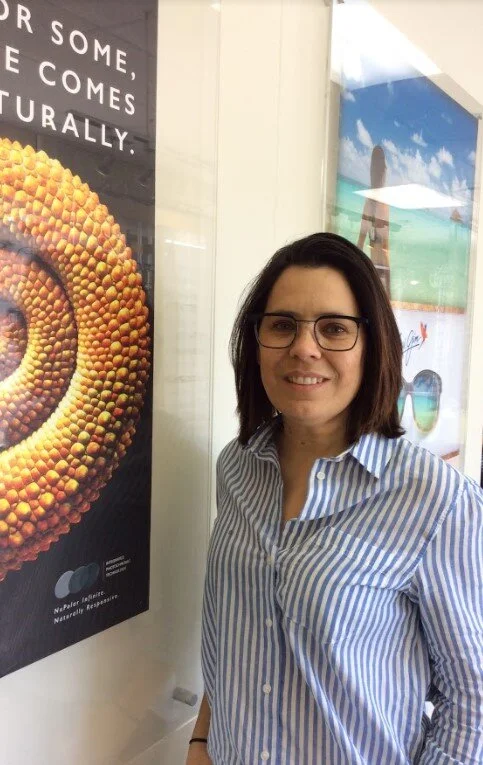
Veronica has been our receptionist for the the past year, you may have already encountered her distinctive Colombian accent. Veronica’s first pair of prescription glasses were from Mexico, where she was living in her teenage years. She is vague about the frame but remembers photochromic lenses, and she thought having glasses was pretty cool. Since then she has had different glasses over the years but never worn full time. She tells me none were as memorable as the eyewear she has chosen since joining us. Check out her recent new glasses.

VF 2 cropped.jpg

Frame: ANNE ET VALENTIN Recover

Lens: Hoya Sync* III lenses with Bluecoat Diamond Finish anti-reflection coating.

*Sync lenses have a boost in the lower lens, similar to a progressive design, but softer zones. Ideal for younger wearers including people who spend a lot of time on phones and screens.

This is your second Anne et Valentin frame.

Veronica: I just love their range. This frame is the complete opposite in style, fine and light after my ‘Diddley’ model which was solid acetate. But it still makes a statement.

How do you find the Sync lenses?

Veronica: They have taken some adjustment. I find the extra strength in the lower lens is good

McDonald Adams is one of 1500 carefully selected retailers world wide.

Anne et Valentin are a French brand born from the wild dream of two opticians from Toulouse, a town in the South-West of France. The couple, looking for graphic and original frames for their friends, decided to create what they couldn’t find. Today, still driven by our fierce independence and our familial state of mind, we continue to develop a vision that embodies our research, fueled by the highest standards and our love for the object itself.

At a time when most of our manufactured products come from South East Asia, this company is still 100% based in France. They describe “Made In France” as a moral commitment. “We have been working with the same factories located in the French Jura mountains since we started, 30 years ago, aside from a few titanium models that we manufacture in Japan, because the very best titanium is Made in Japan.”