Kiwi Designed Technology to End Preventable Blindness

Recently I had a chance to try some innovative new lens technology. Using a simple device I was able to convert an IPhone into a specialized tool to examine eyes. 
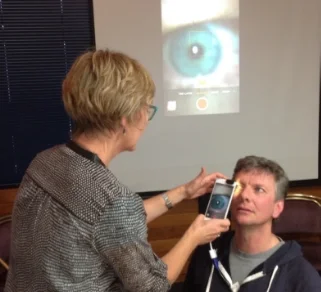
File 28-06-16, 6 29 36 PM.jpeg

With a small group of optometrists I met Hanna Eastvold-Edwins from ODocs Eye Care. ODocs was started by Dr Hong Sheng Chiong. Hong is an ophthalmologist with a passion for technology and gadgets.

Several clinical attachments in third world countries (Kenya, Nepal and Malaysia) were key for Hong. These experiences have given him the insight to the burden of preventable blindness. He believes the problem lies in the access to quality eye care and he is part of the solution, designing his own equipment.

His company, ODocs, develops ultra mobile and economical eye tests and diagnostic devices. He has invented several eye imaging adapters for a mobile phone to diagnose and track eye diseases. He shared his inspiring story at TEDx Auckland. Watch him tell his story here.

The accolades for Hong continue. He was recently Highly Commended at the NZ Innovators 2016 awards in February.

What did I think? The results are impressive. Compared with the optics of our microscopes and specialized lenses? The views using a phone with the attachments were good. I expect these devices will find their way into optometrists rooms as well as out 'in the field' they are designed for.
Project Blaid - The Toyota Effect

Toyota is not a brand we associate with vision. Yet this company is developing a wearable device for the blind and visually impaired.

Called Project Blaid, the device will be worn around the shoulders. Blaid helps users navigate indoor spaces, such as office buildings and shopping malls. It works by helping the wearer identify everyday things like restrooms, escalators, stairs and doors. It is hoped Blaid will fill the gaps left by canes, dogs and basic GPS devices. Wearers will have more information about their surroundings.

Cameras detect the surroundings and communicate to the wearer through speakers and vibration motors. Users will interact with the device through voice recognition and buttons. Future plans include integrated mapping, object identification and facial recognition technologies.

The project reflects the company’s commitment to enrich lives. “Mobility is empowering,” Toyota’s Simon Nagata says. “We want to extend the freedom of mobility for all, no matter their circumstance, location or ability.”

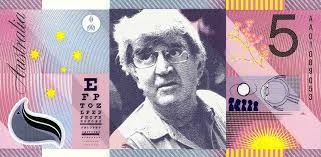
Get Fred On The Fiver...Campaign for Hollows $5

The face of the late, great philanthropist and ophthalmologist Fred Hollows could end up on Australia’s fiver. This is the aim of The Fred Hollows Foundation. New Zealand-born Fred Hollows is well known for improving access to sight-saving cataract surgery. He helped many people in Australia and other countries.

 Early in the 1970s, Hollows worked in the rural outback of Australia. He became especially concerned with the high number of Aborigines who had eye problems. This motivated him to help establish medical services for Aboriginal people throughout Australia. Hollows himself spent three years visiting Aboriginal communities to provide eye care and carry out a survey of eye defects. More than 460 communities were visited, and 62,000 Aboriginal People were examined. This led to 27,000 people treated and 1,000 operations carried out.

Hollows visited Nepal, Eritrea and Vietnam 1987-91. The result was programs to train local technicians to perform eye surgery. Following this laboratories were established in Eritrea and Nepal to manufacture the intraocular lenses needed for cataract surgery. These were produced at cost, approximately A$10 at the time. It has been estimated that more than one million people in the world can see today because of initiatives instigated by Hollows and his Foundation.

Gabi Hollows, Fred Hollows’ widow, launched the campaign “Get Fred on the Fiver” in January this year. Five dollars has been a catch line for Fred Hollows – ‘give Fred five’ and ‘Fivers for Fred’ as $5 was the price of a sight-saving intraocular lens. The Foundation has established a website for Australians to sign a petition campaigning to change the current image on the five dollar note.

The trouble with talking books - a heart felt description

On a daily basis I listen to  many people describe how precious their eyesight is. As an optometrist I am interested in establishing a picture of what is important for the person sitting in my consulting room. Reading is a very common pastime. A keen reader myself I can relate to the simple pleasure found in books. Lynley Hood's account of the problems with talking books, and her grief over the loss of reading will resonate with anyone with a love of reading.

Here is her description of what happened;

"On 20 December 2009 I was reading in bed when my left eye went blurry. "Time to put the light out," I thought.  Next morning it was still blurry. I had lost the central vision in my left eye, suddenly and permanently. Then the vision in my right eye began to deteriorate. 

"The cause turned out to be a rare retinal disorder that goes by the acronym azoor (acute zonal occult outer retinopathy). There is no known effective treatment for azoor. The prognosis is uncertain. 

In the weeks following that first episode, I considered my priorities and made a bucket list ("things to do while I can still see to do them"), but in those anxious early days a single desperate thought possessed me: "Gotta read all those books on my bedside table while I still can!" "

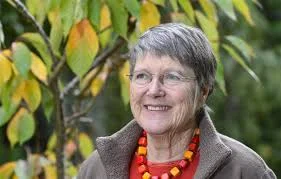
Lynley Hood

Lynley Hood

Award-winning author Lynley Hood is a Dunedin-based scientist, independent scholar and writer. Following her vision loss she has become an advocate and voice for New Zealanders with Visual Impairment. She writes clearly about the shortfall in services for people like herself - read Absence of Vision. Lynley is one of the founding trustees of Vision Impairment Charitable Trust Aoteoroa (VICTA). VICTA describes itself as an energetic new trust working for New Zealanders with uncorrectable vision loss.

Lynley's writing about living with vision loss has included an eloquent description of all her bugbears about talking books. She describes the suggestion that audio books are a substitute for reading print books as an empty platitude.

As both a keen reader and listener to audio books I am taken by her description of all the things she misses now she is no longer able to read print. She describes her grief and her longing to read books. It is sad to hear her describe her loss - I found her description of what she misses in print so eloquent.  She describes the experience of reading books in a way which will connect with all book lovers.

All Lynley's writing gives those of us with good sight a keen awareness of the loss associated with vision impairment. If you are having a tough day read her piece on Becoming Illiterate. It will give you pause for thought and a reason to be grateful.


An Optometrist's Thoughts on Vision for Driving

According to a recent proposal by the Ministry of Transport NZ Drivers may soon be renewing their licences online. Convenient and undoubtedly a huge saving, but with the important change that drivers would renew without vision tests. So what does an optometrist think?

This new proposal will still require first time licence holders, and those over the age of 75, to take an eye test. This seems sensible to me. But for the years in between drivers would make a declaration that they are not aware that their vision has deteriorated since their last renewal, or any deterioration is being managed by wearing corrective or contact lenses. 

It is quite common for people to present for an eye examination and be unaware of deficits in their eyesight. Changes occur gradually so can easily go unnoticed. If we accept there should be a standard for eyesight for drivers, then I think it should be checked at regular intervals. Remember the majority of drivers are tested successfully at AA using a vision screening test. This is straight forward, and when carried out by trained AA staff, it is a cost effective way of testing vision across the general population.

Driver licensing is a key element of road safety. To get a licence, we have to prove we know how to drive safely and follow road rules. Good vision is important for safe driving and most other countries similar to ours require a vision check before you get onto the road. This seems fair and reasonable!

What is under review is the need (and benefit) of checking vision every ten years; apparently we in New Zealand are unique in this requirement. Good vision is important for safe driving but requirements for repeated vision testing may be unnecessary? Policies about re-testing vision at licence renewal vary. New Zealand is one of four places in Australasia that requires vision testing at every licence renewal. Many others only have age-related vision testing starting between ages 70 and 80. 

There were two studies to examine the safety benefits of vision testing. In the first study we examined the crash rates of a sample of over 7,400 drivers who failed a vision check at a licensing agent and were then required to wear contacts or glasses while driving. The crash rates of these drivers before and after failing the vision check and being required to wear contacts or glasses were virtually the same. In the second study the crash rates of drivers in the three-year period before they renewed their licences was studied. Again there was no difference between the crash rates of drivers who failed the eyesight test at renewal and those who passed. For more information see Eye Sight Crash Test Study.

 Like all reform we have to weigh up the risks of reducing regulation. I think testing eyesight before we get onto the road is sensible, and re-testing when we renew our licence is a smart idea as well.

LTSA Discussion Document.

Claire McDonald - Optometrist