
Behavioural Optometry - Your Child’s Vision
Tips for Parents
Vision is more than eyesight - it is how your child interprets, understands and acts upon the information coming in through their eyes. Many children have normal 20/20 eyesight yet struggle in the classroom. This can be due to problems with:
● Eye movements
● Eye teaming
● Eye-hand coordination
● Visual form perception
● Long-sightedness
Visual skills normally improve over time as a child develops. If there are areas where your child is not progressing or school performance is declining, a full vision assessment with Behavioural Optometrist Sally Adams can uncover vision problems which can be improved with glasses and Vision Therapy.
Look out for these signs
□ Red or watery eyes
□ Red or crusted eyelids
□ Frequent styes on lids
□ One eye that turns in or out at times
Does your child complain of
□ Headaches with reading or writing
□ Burning or itchy eyes
□ Print blurs or double vision
□ Words move or “swim” on the page
Does your child, when reading
□ Hold their book close to their eyes
□ Lose place often or needs a finger to keep place
□ Re-read or skip lines or words
□ Confuse similar words
□ Have a short attention span
Does your child, when writing
□ Have untidy writing
□ Use their hand to space writing
□ Repeat letters within words
□ Skip letters, numbers or words
□ Reverse letters & words & numbers
□ Squint, close or covers one eye
□ Tilt their head
□ Have their face close to desk / screen
Other problems
□ Must feel / touch things to understand
□ Often confuses right and left sides
□ Difficulty with similarities & differences
□ Blinks, squints, rubs eyes often
If your child is showing any of these signs or you have any other concerns with how they use their vision or eyes, book a Behavioural Vision Assessment with Sally Adams. Where possible please print and bring this checklist with you to the appointment to help Sally with her assessment.
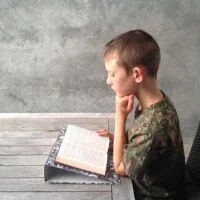
What you can do to develop and support good vision habits for your child:
● Check your child keeps both eyes the same distance to the page or screen, at a distance at least a forearms distance from their chin for reading, or arms distance for computer screens.
● Reading or writing is best on a 20 degree slope rather than flat on the desk.
● Encourage your child to look up and refocus in the distance after every page they read, and at regular intervals when using a screen.
● Sit in a balanced upright position, both feet on the floor; this reduces distraction from fatigue and discomfort while doing homework, reading, drawing, using a computer or tablet.
● All students of all ages and abilities work better in short bursts of 10 minutes or less,
especially those with vision problems. Make sure your child gets up and moves around, ideally goes outside to play after each 20 - 30 minutes of reading, writing or computer / screen time.
● Encourage your child to play sports and do outdoor activities. This improves eye-hand co-ordination, spatial and other visual skills as well as improving concentration.
● If glasses have been prescribed these should be worn all the time while in class. Glasses shouldbe taken off and kept in their case for outdoor activities unless your Optometrist advises full-time wear. Children with eyesight problems or a turned eye usually need to wear their glasses all the time.
Quisque iaculis facilisis lacinia. Mauris euismod pellentesque tellus sit amet mollis.