Human Retinas Grown in a Dish Explain How Colour Vision Develops

This report caught my eye. Science once again pushing the frontiers. Biologists at Johns Hopkins University have grown human retinas from scratch to determine how cells that allow us to see in colour are made. This lays the foundation for therapies for eye diseases such as colour blindness and macular degeneration.
These lab-created “organoids” are a model to study human development on a cellular level. “Everything we examine looks like a normal developing eye, just growing in a dish,” said Robert Johnston, a developmental biologist at Johns Hopkins. “You have a model system that you can manipulate without studying humans directly.”

Johnston’s lab explores how a cell’s fate is determined – or what happens in the womb to turn a developing cell into a specific type of cell, an aspect of human biology that is largely unknown.

His team focuses on the cells that allow people to see blue, red and green – the three cone photoreceptors in the human eye.

While most vision research is done on mice and fish, neither of those species has the dynamic daytime and colour vision of humans. So Johnston’s team created the human eyes they needed — with stem cells.

“Trichromatic colour vision delineates us from most other mammals,” said lead author Kiara Eldred. “Our research is really trying to figure out what pathways these cells take to give us that special colour vision.”

Over months, as the cells grew in the lab and became full-blown retinas, the team found the blue-detecting cells materialised first, followed by the red- and green-detecting ones. In both cases, they found the key to the molecular switch was the ebb and flow of thyroid hormone. Importantly, the level of this hormone wasn’t controlled by the thyroid gland, which of course isn’t in the dish, but entirely by the eye itself.

Understanding how the amount of thyroid hormone dictated whether the cells became blue, or red and green, the team was able to manipulate the outcome, creating retinas that if they were part of a complete human eye, would only see blue, and ones that could only see green and red.

The finding that thyroid hormone is essential for creating red-green cones provides insight into why pre-term babies, who have lowered thyroid hormone levels as they are lacking the maternal supply, have a higher incidence of vision disorders.

“If we can answer what leads a cell to its terminal fate, we are closer to being able to restore colour vision for people who have damaged photoreceptors,” Eldred said. “This is a really beautiful question, both visually and intellectually – what is it that allows us to see colour?”

These findings are a first step for the lab. In the future they would like to use organoids to learn even more about colour vision and the mechanisms involved in the creation of other regions of the retina, such as the macula. Since macular degeneration is one of the leading causes of blindness in people, understanding how to grow a new macula could lead to clinical treatments.

“What’s exciting about this is our work establishes human organoids as a model system to study mechanisms of human development,” Johnston said. “What’s really pushing the limit here is that these organoids take nine months to develop just like a human baby. So what we’re really studying is fetal development.”


Like our service - please review us

Like any business, people check us out online. And increasingly use our convenient online booking feature to arrange appointments. We are looking to grow our online reviews and request your help please. If you would like to leave a review follow this link. You will need to have a Google log in. Thank you.

McDonald Adams Team 2022

A Miracle.

This recent story caught my eye and is worth sharing. New Zealand author Lynley Hood has been a strong advocate for the visually impaired community since she lost her own vision in 2009.

Visual Impairment Charitable Trust Aotearoa (VICTA) started as a result of her lonely and frustrating search for help. VICTA provides an independent consumer voice for New Zealanders with irreversible vision loss who are not blind enough to qualify for membership of Blind Low Vision New Zealand (BLVNZ).

She has also written eloquently about ‘Becoming Illietrate’ where she describes her frustartion with listening to audio books, and her grief at the loss of being able to read text. This is an evocative piece for anyone who loves reading, describing all the pleasure we derive from text and the written word.

Author Dr Lynley Hood

Now, so far unexplained, she has recently regained her vision. This has baffled medical specialists. I suspect she won’t be stopping to consider the why and how, instead I imagine her immersed again in her joy of reading. Read more in this article.

Progressive Lenses: FAQ

Progressives lenses give you freedom from always looking for your glasses! We often hear these lenses are hard to adapt to, but we find most people can wear progressives happily. And often would not be without them. Here are some of the common questions people have about these lenses.

If I get progressives does that mean I need to wear my glasses full time? No. Many people wear progressive glasses at work, or indoors for convenience, but not outdoors for sports and recreation. However, often the best way to get used to these new lenses is to wear them all the time - for a while at least.

What will I experience when getting used to wearing progressive lenses? Sometimes the reading area can seem very restrictive, and there is a feeling that your position has to very precise to see through the clear zone. In most cases this recedes as a result of habitually looking through the correct position unconsciously.

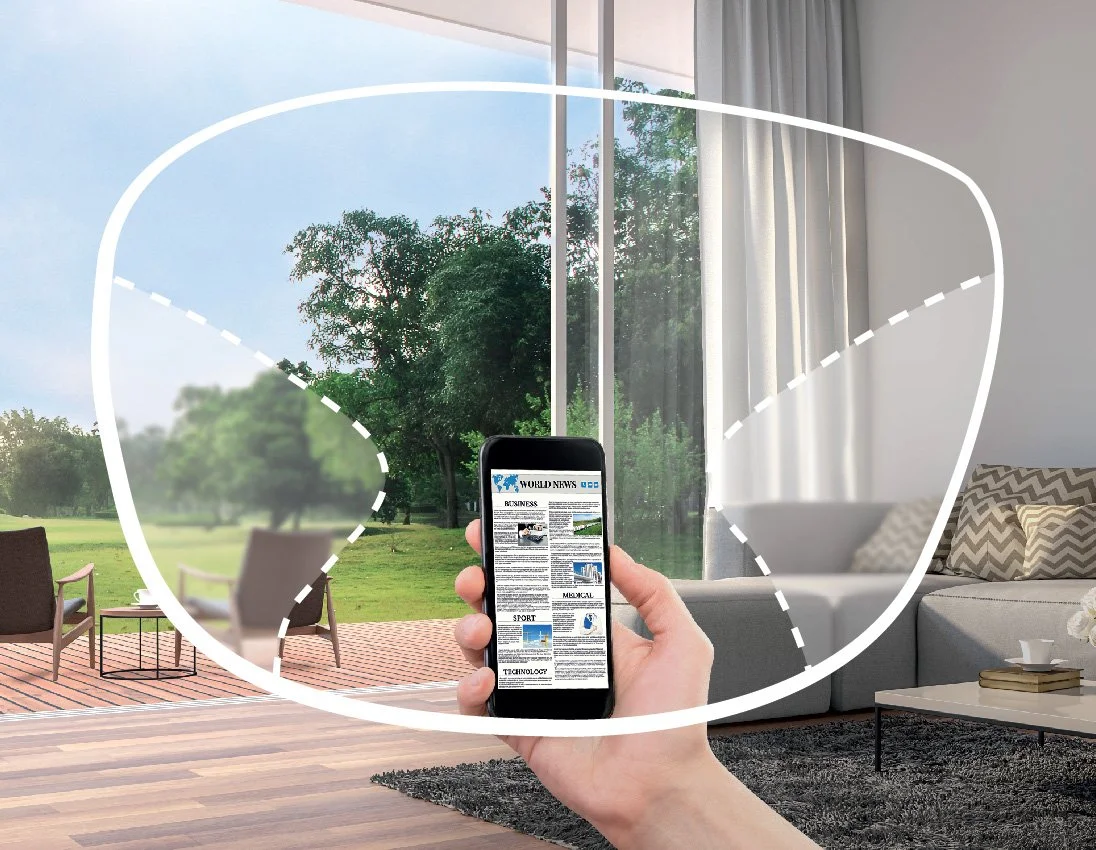
On the whole you have to get used to the individual areas of vision and their position in the spectacles: in the lower area you will see close viewing distances clearly. If you look in the distance, you will do this using the upper portion of the lens to get clear vision. 

Progressive lens areas of vision

All of this is normal and will improve as you adapt to your lenses. Here are our recommendations.

Keep them on. 

You may be tempted to switch back and forth between your progressive lenses and your old glasses, but don’t. The more you wear your progressive lenses, the quicker you’ll get used to them. Even if you don’t ‘need’ any vision correction to look across the room, or your intention was not to wear these glasses full time, it will help to wear them as much as possible at the beginning.

Don’t just move your eyes.
Moving your eyes around the lens can cause eye strain, headaches and discomfort. Get in the habit of moving your whole head, especially when looking through your far and mid-range prescriptions. You will naturally look down when you are reading.

Position your glasses correctly.
Proper alignment will make a difference. Keep your glasses positioned high up on your nose and fitting well behind your ears. This improves your field of clear vision and reduces distortion. 

Be patient.
Stick with your new glasses, and you will train your brain to see properly through the lenses, and looking through the different areas of the lens will become a habit. It may take a few weeks, but you will get there! 

How Progressives Work:
Instead of having just two or three lens powers like bifocals or trifocals, progressive lenses are true multifocal lenses that provide a seamless progression of many lens powers for all viewing distances.
A “corridor" of optimum lens power runs vertically down each progressive lens. We have taken careful measurements of your eyes and glasses frame to ensure this corridor is in just the right location so that your eyes can naturally access the various powers within the lens. This design allows you to look up to see clearly across the room and in the distance. You also can look ahead to view your computer in the intermediate zone and drop your gaze downward to read and do fine work through the near zone of the lenses.
If you glance to the very far right or left, you may notice your vision is slightly wavy. You may also notice this wavy vision in your periphery at first when you move your head side to side, but after a very short time you will become unaware of this.
These are completely natural, and will diminish within a short period of time as you adapt to your new progressives.

Driving Take care when driving - do not use new progressives if you are not confident in the early days.

Enjoy your new glasses!

So, you have 'early' macular degeneration, what now?

Awareness of macular degeneration is growing. Often people are coming for an eye examination because of public education campaigns about the importance of regular eyecare. This is a very good thing and a message we thoroughly support.

From an optometrist’s viewpoint it is always a heartsink moment when, as part of a routine appointment, I see early signs of macular degeneration. Depending on what people know about this condition, hearing this information can be very distressing. This can be a shock which can impact on understanding or even hearing the rest of the consultation and the implications of the diagnosis.

But let’s give it some context.

Nine out of ten cases of macular degeneration are described as ‘dry’. While vision does deteriorate, progression can be very slow.

What about the 10th case? These are commonly referred to as ‘wet’ macular degeneration. The change in vision is usually much more noticeable, including distortion. But there is treatment. This is delivered by injection. Many people have macular degeneration treated this way, and sometimes the outcomes can be quite good.

If you are told you have early signs of macular degeneration my recommendations are:

A healthy diet can help your eye health

  • Read the material from Macular Degeneration NZ - their handouts and website are excellent.

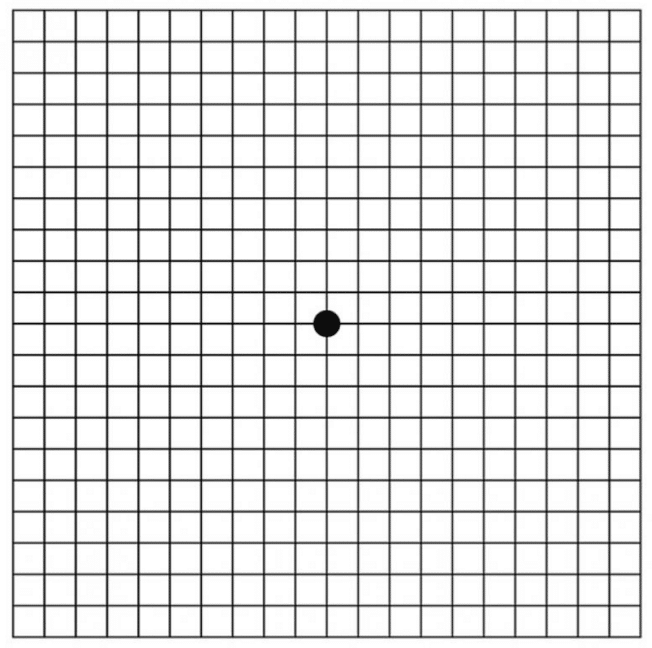
  • Put the Amsler Grid somewhere handy and check it regularly.

  • Do an audit of your diet to make sure you are covering all the recommendations. If not, consider supplements.

  • Take a careful look at home lighting and make any improvement possible. Particularly useful is to increase light levels in places you like to read. This can make an appreciable impact on your reading. Daylight lamps are excellent.

  • Same goes for magnifying glasses. Often these can be buried in a drawer somewhere. Clean them and leave them in the kitchen and bathroom where they are easily accessible for reading small print on labels.

  • Prepare for the worst and hope for the best, but start small. Don’t leap straight to thinking about not driving and having to move house. Instead channel that energy into trying new technology. Have you listened to an audio book from the library? Can you take a photo of a label with your phone and magnify it? Have you ordered groceries online?

  • Talk to your friends and peers. There may be people you know in the same situation, and hearing their stories can be very helpful.

The Amsler grid can help detect early sign of retinal disease and monitor changes in vision after diagnosis.

Remember to talk to your optometrist. When you have had time to process the information if you have questions come back to us, we are here to help.