

Disposable contact lenses are brilliant in terms of breathability and hygiene. But like so many other items in our daily lives they come in plastic packaging. Many people have asked about options for recycling contact lens packaging - good news, now you can do so and it is very easy.
If you have Ascend, Biofinity, MiSight or Proclear contact lenses, the blisters are classified #5/PP Plastic. This is a designation shared by a wide range of medical and food packaging. The cartons and cardboard packing are classified as recyclable paper and can also go in your regular household collections. The small piece of foil topping is the only part of packaging which should be discarded. One more step to help protect our environment.
McDonald Adams Science Scholarship Rodney College
Sally Adams was at Rodney College prizegiving to present our annual McDonald Adams Science Scholarship. The winner this year was Lachlan Campbell. Lachlan plans to attend the University of Auckland, studying towards a Bachelor of Engineering with Honours. At this stage he thinks he may do Mechatronics or Engineering Science.
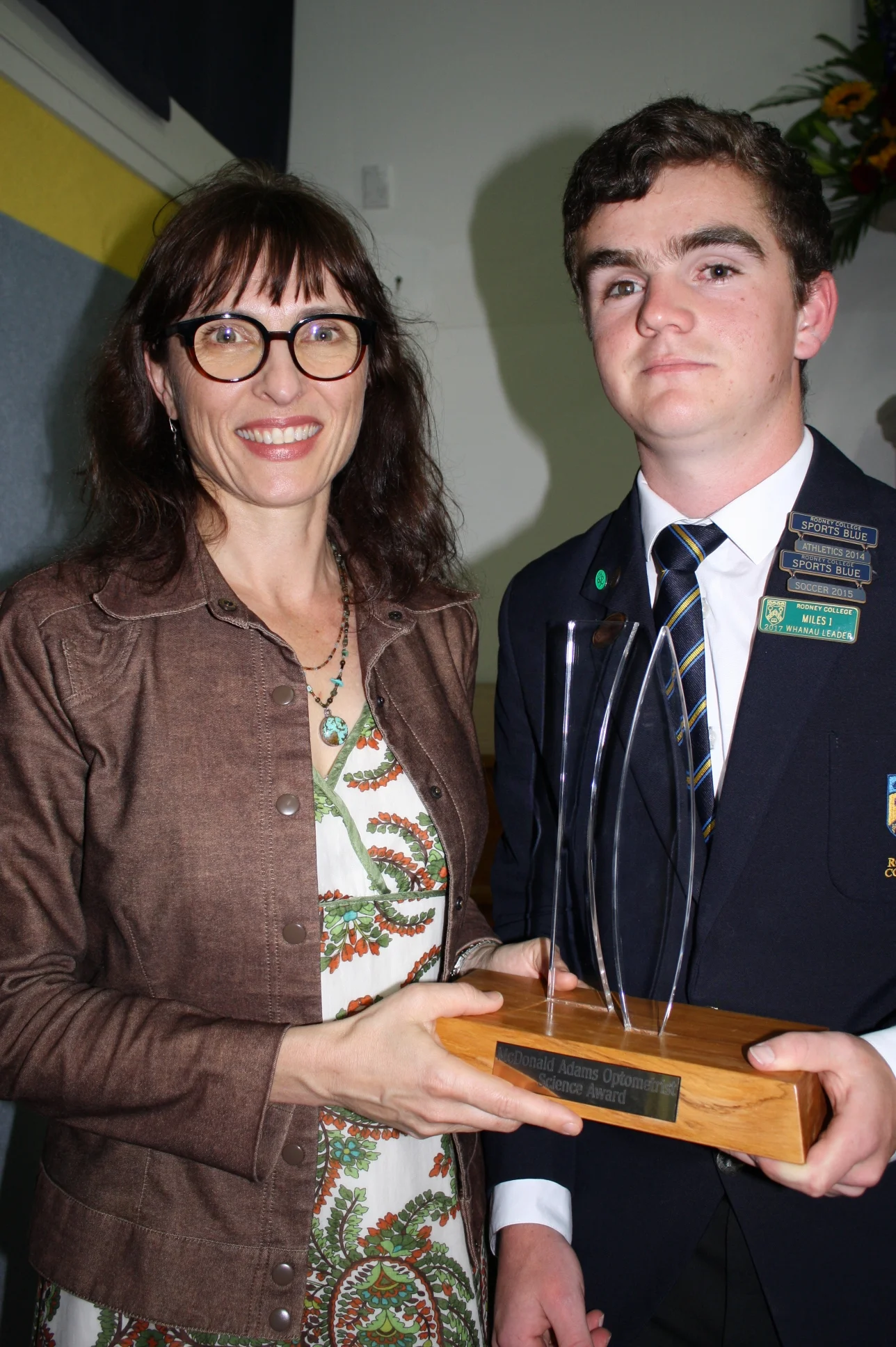
Sally Adams presenting Lachlan Campbell with his Scholarship
McDonald Adams Science Scholarship - Mahurangi College
Hannah Dunn was this year's recipient of our McDonald Adams Science Scholarship. She is off to the University of Auckland to study Bachelor of Science, majoring in chemistry. Her long term goal is to advance into post graduate study in Forensic science.

Claire McDonald presenting Hannah Dunn her Science Scholarship
Omega-3 for Dry Eye - Helping you make tears
Omega-3s are essential fatty acids. "Essential" means their inclusion in your diet is essential for good health. Omega-3s cannot be produced by the body. The two best sources of omega-3s are dark oily cold-water fish, and flax seed. As a population New Zealanders are omega-3 deficient and have the lowest omega-3 dietary intake in the world.
Omega-6s are another group of essential fatty acids which we get through eating beef dairy, vegetable cooking oils, and vegetable shortenings (i.e. biscuits, potato chips etc). The ideal ratio of omega-3s to omega-6s is 1:2. For kiwis that ratio has been estimated to be as low as 1:10.
Omega-3s are helpful for dry eye in these four ways:
Decrease inflammations (signs of inflamation are redness, irritation, scratchy eyes)
- Decrease cell death (called apoptosis)
- Stimulate tear secretion
- Improve meibomian gland oil secretion (these are the vital oils which create better tear film)
The take home is omega-3s are very beneficial in dry eye treatment. Try them and see. We have two omega-3 supplements; Thera Tears, and Lacritec. Both are designed specifically for dry eyes. Anecdotally we find people taking these omega-3s notice a difference within 3-4 weeks of using these supplements.
There is a lot of cool science driving these benefits, if you are interested in more details please read on!
Omega-3s decrease inflammation. Once eaten, omega-3s are elongated by enzymes to produce anti-inflammatory compounds: prostaglandin E3 (PGE3) and anti-inflammatory leukotriene B5 (LTB5).
There is an abundance of clinical evidence that taking omega-3s decreases inflammation seen in joints in rheumatoid arthritis and in dermatitis. These anti-inflammatory effects help explain why omega-3s have been helpful for people symptoms of meibomian gland dysfunction and blepharitis.
Omega-3s decrease apoptosis (programmed cell death) through suppressing TNF-a. TNF-a increases programmed cell death in the lacrimal gland, where aqueous tears are produced. This contributes to the decrease in tear production, and increase in tear film osmolarity that drives dry-eye ocular surface disease.
Restasis® (not yet available in NZ), is a drug administered as an eye drop (it is toxic systemically) also inhibits TNF-a production. Applied as a drop, it achieves good concentrations on the eye surface but is not thought to reach the orbital lacrimal gland in humans. Omega-3s, taken by mouth, reach the lacrimal gland by the blood supply and the ocular surface via meibomian gland secretions.
Omega-3's stimulate tear secretion. There are more positive effects of suppressing pro-inflammatory cytokines. We now know the pro-inflammatory cytokines TNF-a , IL-1a , and IL-1b, impair tear secretion in lacrimal gland disease-based dry eye by inhibiting the release of neurotransmitters from neural synapses, and interfering with the secretory response of lacrimal gland acinar cells to stimulation. This is probably the main mechanism by which tear secretion decreases in dry eye.
The importance of this was illustrated in work showing when TNF-a gene expression is blocked by gene therapy in an animal model, autoimmune lacrimal gland disease can be reversed, and tear secretion restored. The relevance of this animal model is supported by epidemiological data that indicates that the risk for dry eye decreases with increased dietary intake of omega-3s, as well as an additional study that finds that Sjögren's patients have a lower dietary intake of omega-3s, including EPA and DHA, than age-matched controls.
While EPA is central in blocking the gene expression of pro-inflammatory cytokines, DHA may help in a complementary way. Neural synapses contain among the highest concentration of DHA in the body and research has shown that dietary supplementation with DHA restores neural DHA levels and improves age-related declines in synapse function. DHA may reduce the ability of pro-inflammatory cytokines in the lacrimal gland to inhibit signal transduction at the synapse. Lending credence to this hypothesis is the finding that severity of dry eye in Sjögren's patients has been found to be inversely proportional to membrane and serum levels of DHA.
Omega-3s affect the lacrimal gland in another way. EPA and DHA and alpha-linolenic acid (ALA) from flaxseed oil competitively inhibit conversion of omega-6s to arachidonic acid (AA), promoting the conversion of DGLA to prostaglandin E1 (PGE1). PGE1 also has anti-inflammatory properties and, in addition, acts on the receptors, increasing cyclic AMP (cAMP). PGE1 and cAMP have been shown to stimulate aqueous tear secretion.
Omega 3's, and the meibomian gland oils. Meibomian glands use essential fatty acids to synthesise oil (meibomian gland secretions). Dietary intake of omega-3s in general, and EPA and DHA in particular, have been shown to affect the polar lipid profiles of meibum as observed by HPLC. THinning and clearing of meibomian gland secretions has been observed with omega-3 supplementation.
There have been some attempts to treat dry eye with the omega-6 essential fatty acid gamma linolenic acid (GLA) found in black currant seed oil, evening primrose oil and borage oil. There are two published studies that concluded GLA was not effective for dry eye.
Omega-3 supplements provide a foundation for a broad spectrum of dry eye treatment regimens by decreasing inflammation, and improving the oil and water layers of the tear film. We have two supplements available; Lacritec and Thera Tears. Ask us if these could help you.
Nick Lee presents at International Myopia Conference
We have been following Nick's progress since he won our McDonald Adams Science Scholarship in 2013 in his final year at Mahurangi College. He succeeded in gaining entry to the Optometry course at Auckland University and Nick has one year left to complete his degree.
Nick recently attended the International Myopia Conference in Birmingham to present the results of his research. The project was titled "Effect of Atropine on Human Multifocal Electroretinogram Responses to Defocus."

Myopia (short-sightedness) is a growing epidemic across the globe. It is predicted that 50% of the world’s population will be myopic by 2050. The optometric community has employed several strategies to slow progression of myopia - myopia control.
One myopia control option is Atropine eye drops. Atropine usually acts as a muscarinic receptor blocker, forcing the eye's focussing system to relax. Its mechanism of slowing myopia progression is not known.
Previous studies have shown electrical responses from the retina. Nick's study measured these to find out if this is where atropine is acting.
Compared to eyes with clear focus (know as emmetropia) positive defocus increases the signal; negative defocus decreases the signal. A positive defocus is protective against myopia progression; negative defocus accelerates myopia progression.
This study found atropine to enhance only the positive (protective) component of this electrical response in the peripheral retina. Although a full model is still not able to be formed, this finding is very interesting and fits in well with other literature presented at the International Myopia Conference.
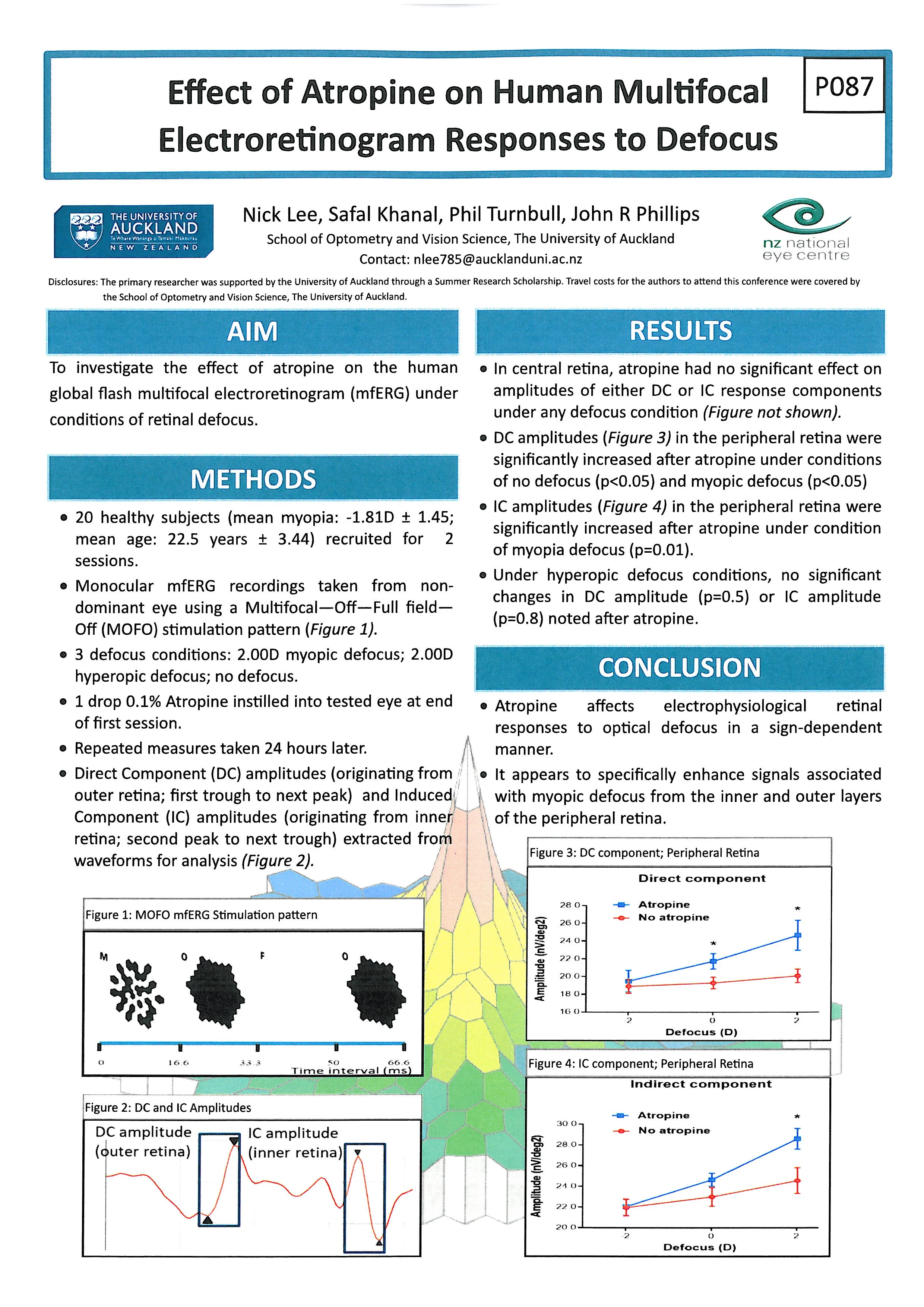
Nick's scientific poster presented at the International Myopia Conference (Birmingham, 2017) by Nick Lee, Safal Khanal, Phillip Turnbull and John Phillips. For more information please contact: nlee785@aucklanduni.ac.nz.
Book Seat - a low vision reading helper
Recently we discovered these novel Book Seats at Matakana Village Bookshop. These will be brilliant for anyone who loves reading. The seat can be on your lap or on a table. Books and tablets sit propped at an ideal reading angle and reading distance.

For someone with low vision, who reads with stronger glasses, books usually need to be held at closer range. Large print books help people with low vision continue to enjoy reading, but these are often heavy. Often someone who has reduced vision will find they struggle to read for extended periods of time, say half an hour. The challenge is to keep everything in optimum postion. This Book Seat will support books and help keep them at an ideal reading distance.
These are available in a range of colours. Call in to see our demo or visit Matakana Village Books to see the full range.
Contact www.matakanavillagebooks.co.nz for more information.